

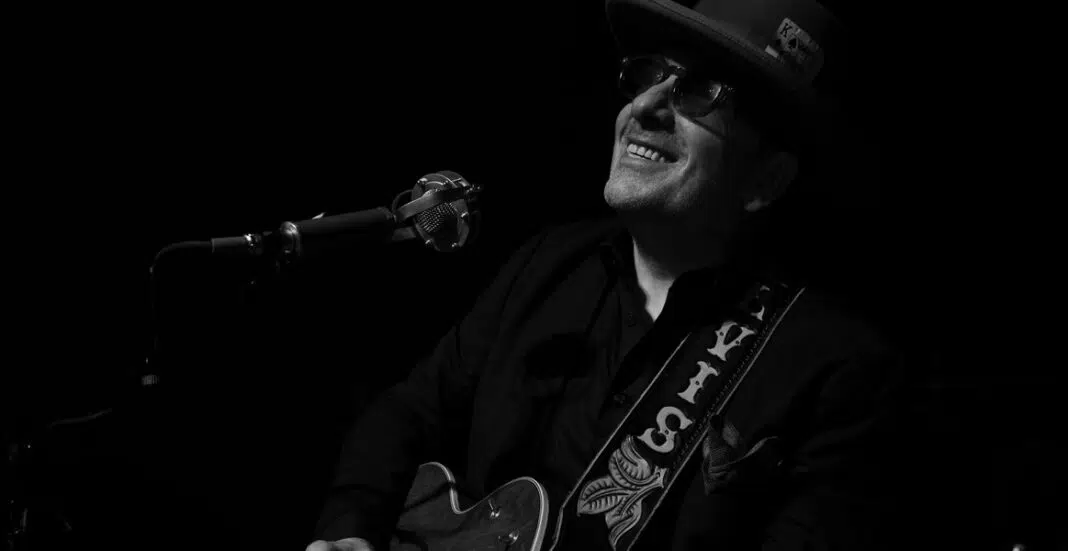
When songs last for fifty years, it is never just nostalgia. With “Radio Soul!: The Early Songs of Elvis Costello”, Elvis Costello & The Imposters, joined by Charlie Sexton, bring the early catalogue back to the stage and run it through the present tense. On July 9, 2026 at the Jahrhunderthalle Frankfurt, this is not about preservation. It is about friction, energy and why these songs still hit today. Classics meet surprises in a set that recharges the past instead of framing it.
“Radio Soul” sounds like a retrospective, yet your shows feel like a counterattack. Why dive into these early songs right now?
I must tell you that the title, “The Early Songs” is said in jest and with mischief. “The Songs of The Late Elvis Costello” would have been just too tragic.
“Early” could of course be taken to mean “earlier today”. I am easily the less nostalgic person you will ever encounter. I have respect and curiosity about the past – even my own – rather than any wish to live my life over again.
You cover material from 1977 to 1986. Where did you deliberately break with the originals instead of recreating them?
Yes, this period takes in the songs from eleven albums, so there are choices made from night to night. Sometimes we play songs in their original arrangements, other times we tear up the blueprints and start again. It depends on the mood, the venue and of course, the audience.
Concert halls invite the widest range of dynamics, as to incessantly fill a hall with sound can be oppressive and miss the opportunity to create a more intimate moment and play ssong like “Almost Blue” or “Indoor Fireworks”
When a track like “Watching The Detectives” hits the stage today, what changes through time, audience and your own biography?
I think of “Detectives” as being the first real “record” I made, in that the studio and record production really coloured the drama the song.
I think this is why this song has been played in so many different arrangements over the years, – mostly recently with WDR Big Band in Köln – but also lived-mixed performance at Newport Jazz with an electric guitar, piano, a three-piece horn section and double bass playing over samples and sonics presented with a dub and remix approach
We will appear as a quintet with Charlie Sexton augmenting The Imposters, so almost anything is possible.
How does your creative process work for re-interpretation. Do you approach arrangements analytically or does it emerge in the room from the band’s energy?
I sometimes like to alter the tempo radically or even change to the key but only to place the melody in a more intimate register. This is never done analytically, it is determined by emotion or curiosity.
We change the show from night to night and place to place, so there is a decent amount of risk. People pay to see you walk a high wire and sometimes you fall off. We are circus performers and vaudevillians at heart.
Three members of The Imposters were part of the original recordings. How do you balance authenticity and evolution in rehearsals?
Two of The Imposters have played on most of the recordings I’ve made since 1977, after the release of “My Aim Is True”.
If they and I had not learned anything 50 years, something would badly wrong.
That we now play with Davey and Charlie brings two more voices to the stage, allowing us to add vocal harmonies and guitar motifs that were absent from Attractions shows – which veered from intense to incoherent.
Charlie Sexton brings a distinct voice. Where did he surprise or challenge you in the process?
Charlie is a remarkable ensemble player. His contribution is often subtle and supportive, either playing a guitar part that I overdubbed in the studio but could not replicate while singing or in augmenting lines that Steve Nieve may have played, which frees Steve to play more expressively.
Occasionally I will encourage Charlie to step forward and really let loose. He is a great soloist but we also had some hijinks trading lines on some of the late-in-the-set songs, once the story is largely told.
You stress that you are not a tribute band. What is the clear difference on stage, especially when the audience expects the familiar?
We are very different to “The Australian Doors”, “The Bosnian Floyd” or “Nearly Diamond”. I don’t think anyone is going to be confused once we start playing but of course, we are all holograms.
We make no promises to be either familiar or faithful, only to be good. If we happen to slip in a newer tune, say, “American Gangster Time” or “We Are All Cowards Now”, I’m sure you’ll know why.
The July 9 show at the Jahrhunderthalle Frankfurt. What should we expect. A tightly structured narrative set or maximum spontaneity?
We apparently walk in the footsteps of Duke Ellington, Louis Armstrong and the Grateful Dead, so it would appear anything is possible.
Your songs are political, personal and often uncomfortable. Which early themes feel even sharper today?
I’ve always found more endurance to songs that look at matters from more than one angle.
That’s true of love and war.
Having songs with titles such as, “Accidents Will Happen”, “Brilliant Mistake” or “Waiting For The End Of World” may appear as it I was trying to predict the future. That is not the case.
After the US run you are bringing the tour to Germany in summer 2026. What are the next tour plans. Is “Radio Soul” a chapter or the start of something bigger?
There are presently no plans for further editions of “Radio Soul” or other dates in 2026 but several other things are about to happen, I just can’t tell you about them right now.
You’ll just have to “Watch This Space”
Thank you for your time and your openness. Your music proves how alive a catalogue can be when it is not treated gently. We wish you a powerful tour, strong nights in Frankfurt and beyond, and a great response to “Radio Soul!”.
Interview by CK
© Ray Di Pietro
EVENTIM Ticketshop
DE
Von „Radio Radio“ bis heute. Elvis Costello & The Imposters entzünden Radiosoul in Frankfurt am Main
Wenn Songs fünfzig Jahre überdauern, geht es nie nur um Nostalgie. Mit „Radio Soul!: The Early Songs of Elvis Costello“ bringen Elvis Costello & The Imposters, gemeinsam mit Charlie Sexton, ihr frühes Repertoire zurück auf die Bühne und holen es ins Hier und Jetzt. Am 9. Juli 2026 in der Jahrhunderthalle Frankfurt geht es nicht um Bewahrung. Es geht um Reibung, Energie und darum, warum diese Songs heute noch treffen. Klassiker treffen auf Überraschungen in einem Set, das die Vergangenheit neu auflädt statt sie auszustellen.
„Radio Soul“ klingt wie eine Rückschau, eure Shows wirken aber eher wie ein Gegenangriff. Warum jetzt zurück zu den frühen Songs?
Ich muss sagen, der Titel „The Early Songs“ ist mit einem Augenzwinkern gemeint. „The Songs of The Late Elvis Costello“ wäre einfach zu tragisch gewesen.
„Früh“ kann man natürlich auch als „früher heute“ verstehen. Ich bin wahrscheinlich der am wenigsten nostalgische Mensch, dem du begegnest. Ich habe Respekt und Neugier für die Vergangenheit, auch für meine eigene, aber keinen Wunsch, mein Leben noch einmal zu leben.
Ihr spielt Material von 1977 bis 1986. Wo brecht ihr bewusst mit den Originalen statt sie zu reproduzieren?
Dieser Zeitraum umfasst Songs aus elf Alben. Deshalb treffen wir von Abend zu Abend neue Entscheidungen. Manchmal spielen wir Stücke nah an den Originalarrangements, manchmal zerreißen wir die Baupläne komplett und fangen neu an. Das hängt von der Stimmung ab, vom Ort und natürlich vom Publikum.
Konzerthallen erlauben große Dynamik. Wenn man einen Saal permanent mit Sound füllt, wirkt das schnell erdrückend. Man verpasst die Chance auf intime Momente mit Songs wie „Almost Blue“ oder „Indoor Fireworks“.
Wenn ein Stück wie „Watching The Detectives“ heute live gespielt wird, was verändert sich durch Zeit, Publikum und deine eigene Biografie?
Ich sehe „Detectives“ als die erste richtige Aufnahme, die ich gemacht habe, weil Studio und Produktion die Dramaturgie stark geprägt haben.
Vielleicht wird der Song deshalb seit Jahren in so vielen Versionen gespielt. Zuletzt mit der WDR Big Band in Köln. Aber auch als live gemixte Performance beim Newport Jazz Festival mit E-Gitarre, Klavier, Bläsern und Kontrabass über Samples und Dub-Elemente.
Wir treten als Quintett auf, mit Charlie Sexton an der Seite von The Imposters. Dadurch ist fast alles möglich.
Wie funktioniert euer kreativer Prozess bei Neuinterpretationen. Analytisch oder aus der Energie im Raum heraus?
Manchmal verändere ich das Tempo radikal oder sogar die Tonart, um die Melodie intimer wirken zu lassen. Das passiert nicht analytisch. Es kommt aus Emotion oder Neugier.
Wir verändern die Show jeden Abend und an jedem Ort. Da steckt immer ein Risiko drin. Die Leute zahlen auch dafür, dass man über ein Drahtseil läuft. Und manchmal fällt man runter. Wir sind im Kern Zirkusleute und Vaudeville-Künstler.
Drei Mitglieder von The Imposters waren schon bei den Originalaufnahmen dabei. Wie haltet ihr die Balance zwischen Authentizität und Entwicklung?
Zwei Mitglieder der Band haben an fast allen Aufnahmen mitgewirkt, die ich seit 1977 gemacht habe, nach „My Aim Is True“.
Wenn wir in fünfzig Jahren nichts gelernt hätten, wäre das ein Problem.
Mit Davey und Charlie haben wir zwei zusätzliche Stimmen auf der Bühne. Das erlaubt uns neue Gesangsharmonien und Gitarrenmotive, die es früher so nicht gab.
Charlie Sexton bringt eine eigene Handschrift mit. Wo hat er dich überrascht?
Charlie ist ein herausragender Ensemble-Spieler. Oft arbeitet er sehr subtil und unterstützt das Gesamtbild. Er spielt Gitarrenparts, die ich im Studio overdubbt habe und live nicht gleichzeitig singen konnte. Oder er ergänzt Linien von Steve Nieve, sodass dieser freier spielen kann.
Manchmal fordere ich ihn bewusst heraus, nach vorne zu gehen. Er ist ein starker Solist. Gegen Ende der Sets tauschen wir auch gerne Linien und treiben uns gegenseitig an.
Ihr betont, dass ihr keine Tribute-Band seid. Was unterscheidet euch auf der Bühne?
Wir sind etwas völlig anderes als typische Coverbands. Das wird sofort klar, wenn wir anfangen zu spielen.
Wir versprechen weder Vertrautheit noch Werktreue. Wir versprechen nur, gut zu sein. Wenn dann ein neuerer Song wie „American Gangster Time“ oder „We Are All Cowards Now“ auftaucht, hat das seinen Grund.
Das Konzert am 9. Juli in der Jahrhunderthalle Frankfurt. Was erwartet uns. Klare Dramaturgie oder maximale Spontaneität?
Wir bewegen uns in einer Tradition, in der alles möglich ist. Insofern bleibt es offen.
Deine Songs sind politisch, persönlich und oft unbequem. Welche frühen Themen wirken heute noch schärfer?
Songs halten länger, wenn sie Dinge aus mehreren Perspektiven betrachten.
Das gilt für Liebe und Krieg.
Titel wie „Accidents Will Happen“, „Brilliant Mistake“ oder „Waiting For The End Of The World“ wirken im Rückblick fast wie Vorhersagen. Das waren sie aber nicht.
Nach der US-Tour kommt ihr im Sommer 2026 nach Deutschland. Wie geht es weiter. Ist „Radio Soul“ ein Kapitel oder der Beginn von mehr?
Aktuell gibt es keine weiteren Pläne für „Radio Soul“ oder zusätzliche Termine in 2026. Aber es stehen einige Dinge an, über die ich noch nicht sprechen kann.
Ihr müsst einfach dranbleiben.
Vielen Dank für das Gespräch und die Offenheit. Deine Musik zeigt, wie lebendig ein Katalog bleibt, wenn man ihn nicht konserviert. Wir wünschen eine starke Tour, intensive Abende in Frankfurt und darüber hinaus und viel Resonanz für „Radio Soul“.
Interview von CK
© Ray Di Pietro